





20 Years of Design8: Standing on Our Own Two Feet (2005 – 2010)
Orlando finds himself suddenly standing on his own two feet, building Design8 bv from the ground up.

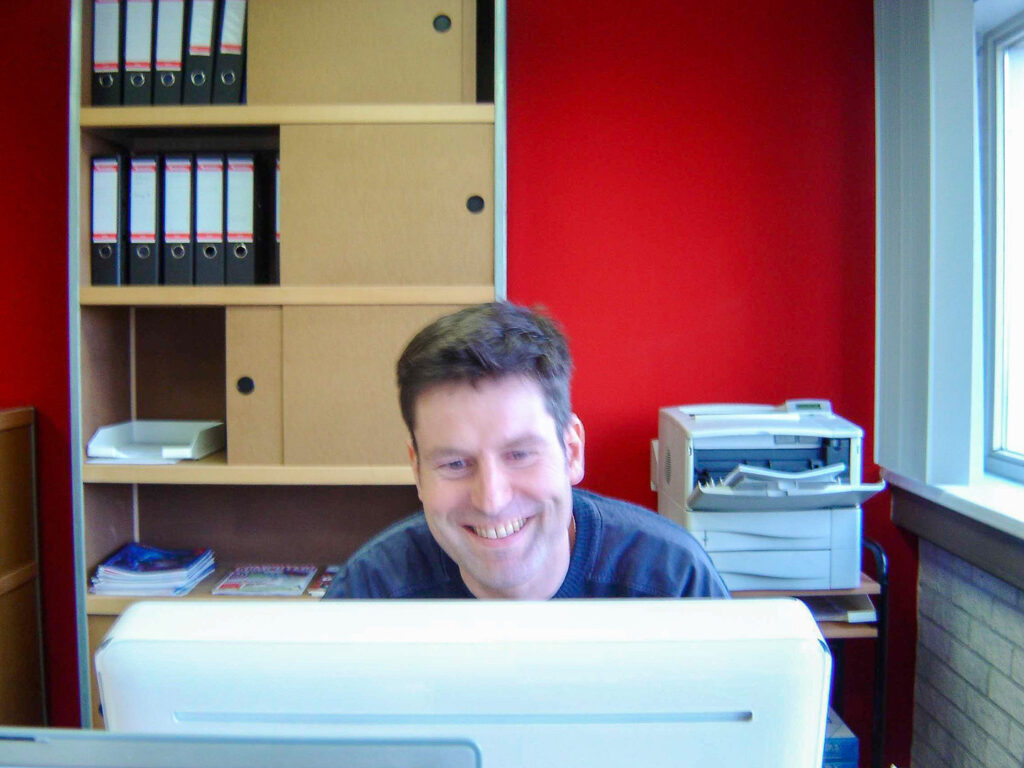
Standing on my own two feet! I closed out my first blog post with the realisation that SketchUp had given me everything I needed to make my own way. I seized that opportunity, though I didn’t do it by myself.
Help Arrives
Things were getting increasingly busy with all the activities, orders, and technical support, so an extra pair of hands was more than welcome. That’s why Lukas Lagerweij joined me in 2004. Much as I had once started in the 3D software market, Lukas came on board as an Industrial Design student, helping with tech support, training, and delivering demos. Initially, for the solid modeller, Concepts Unlimited — but the moment Lukas was assigned a SketchUp licence, the industrial designer fell head over heels for it. In no time, he was modelling everything in 3D in SketchUp.
Lukas worked both on and with Concepts Unlimited, a genuinely precise 3D NURBS design tool — nothing like the 3D sketching approach of SketchUp. My surprise was considerable, but it confirmed something once again: SketchUp is a friend to everyone.
In the summer of 2005, a friend tipped me off about someone who was open to work. Ben van Steenwijk came in for a chat, and we hit it off straight away. I showed him the ropes of our in-house CRM system, and whenever an order came in, Ben took care of it. That’s hardly comparable to the situation today, more than twenty years on. Ben now heads up his own department, with several people handling and managing orders day in, day out, almost without pause.
SketchUp User Day
That summer, we held the first Benelux SketchUp User Day! I hired a room at the Chamber of Commerce, and we filled the space with what I’d estimate was around fifty SketchUp enthusiasts and resellers. The SketchUp Channel Manager at the time flew over from London.
The Municipality of Zoetermeer presented how they were using SketchUp for shadow studies — right up to and including in court proceedings. Where they had previously relied on multiple floor plans showing projected shadows as hatched areas, SketchUp allowed them to glide the sun across a 3D model in real time. Remarkable! Incidentally, the Municipality of Zoetermeer remains an avid SketchUp user to this day.
The SketchUp Channel Manager introduced SketchUp version 5, which brought with it the new Sandbox Tools — something you can find documented in our changelogs as well. Shaping terrain in SketchUp became considerably easier, as @Last Software continued its efforts to make SketchUp appealing to a broader audience.
Resellers were present too. Alfazet, a reseller from the very beginning, was even selling 3D glasses of the kind older readers may remember from Jaws 3D at the cinema. And new resellers had come along to introduce themselves, among them VMV CAD-Adviseurs, as we continued to build out the reseller channel at a steady pace.
Sinks on Marktplaats
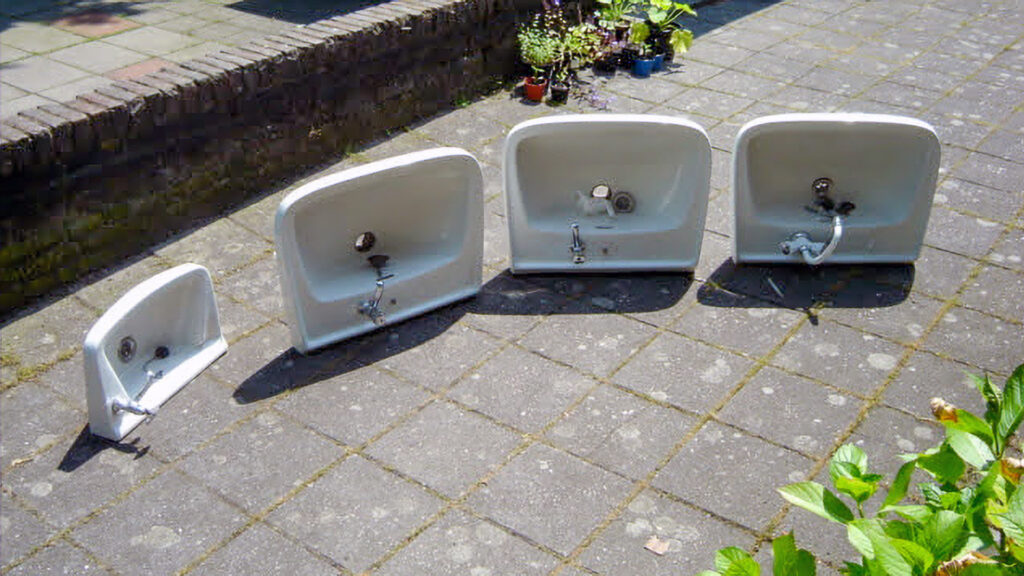
The most driven resellers turned out to be the ones who came to us. I remember being called while driving by someone desperate to start selling SketchUp. It turned into a pleasant conversation, and that reseller remains a top-tier partner to this day. But I had to ask: how on earth did you get my number? I used my mobile for business, but sparingly — everything went through the landline or the answering service. “Well”, came the reply, “you’ve got those lovely sinks listed on Marktplaats (a Dutch classifieds site), and your number was right there.” Fair enough. The hazards of an unusual name — but rather wonderfully inventive, you have to admit.
New Technology Turns the Manufacturing World Upside Down
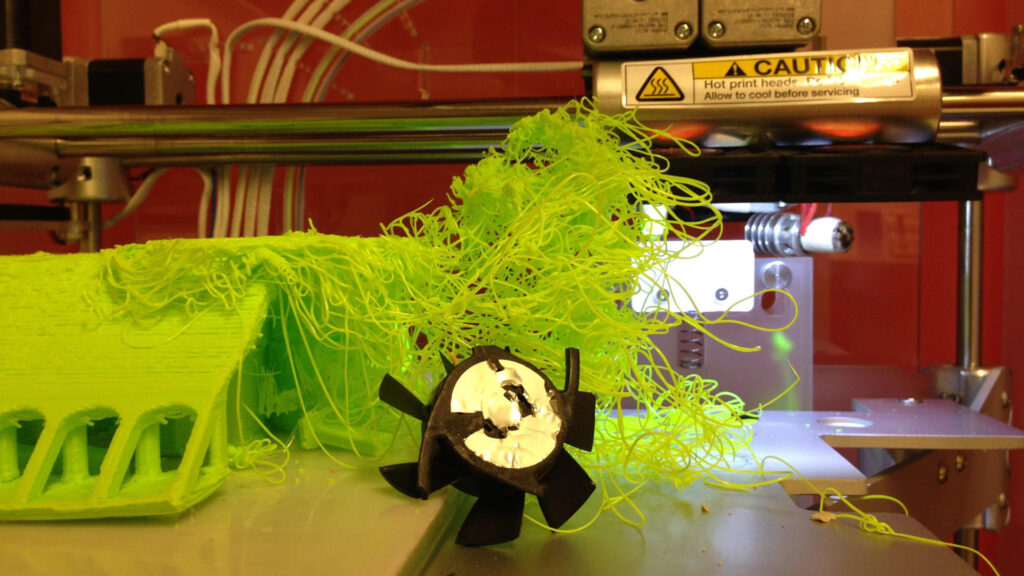
I had by this point heard from my English counterpart that he had officially become a reseller of 3D printers. 3D printers! A tremendously interesting development that was set to turn the manufacturing world on its head. And the design world along with it, surely?
3D printing itself wasn’t new — the technology dated back to the 1980s. But now affordable models were coming to market at a cost of only a few hundred thousand. I was intrigued and made contact with ZCorporation, which sold powder-based printers that just about fit inside a lift. Handy, as it meant we could run one during the SketchUp User Day at the Chamber of Commerce.
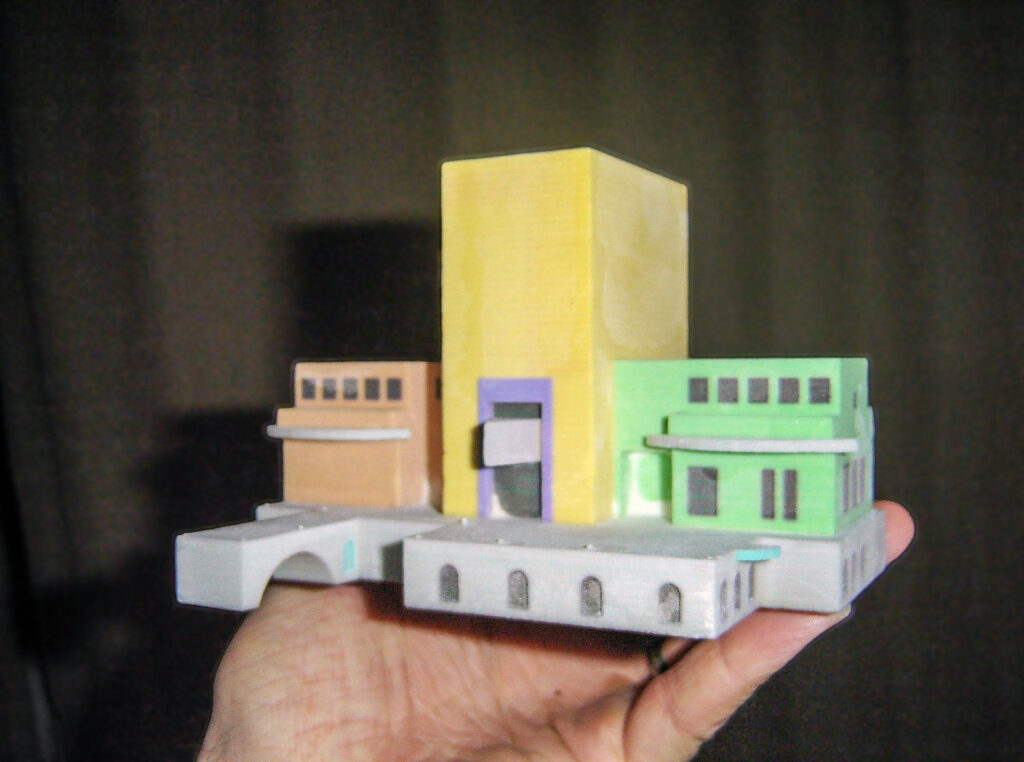
Inside sat a build plate roughly A4 in size, on which a 3D form was built up layer by layer in tenths of millimetres — alternating layers of powder and binder. The binder could be coloured, which meant the result was a full-colour 3D print. Once finished, you shook off the loose powder, and you were left with a 3D model. A quick spray of superglue, and done.
We also came to the rescue of Daalderop, a manufacturer of boilers and central heating systems, and a fellow Tiel resident as well as a Concepts Unlimited customer. They had just completed development of an extremely compact kitchen boiler designed to fit behind the skirting board. With a trade fair coming up, they wanted to show a prototype. We received their 3D CAD model, printed it out on the ZCorp machine, and finished it off with superglue, paint, and stickers. The result was well worth showing.
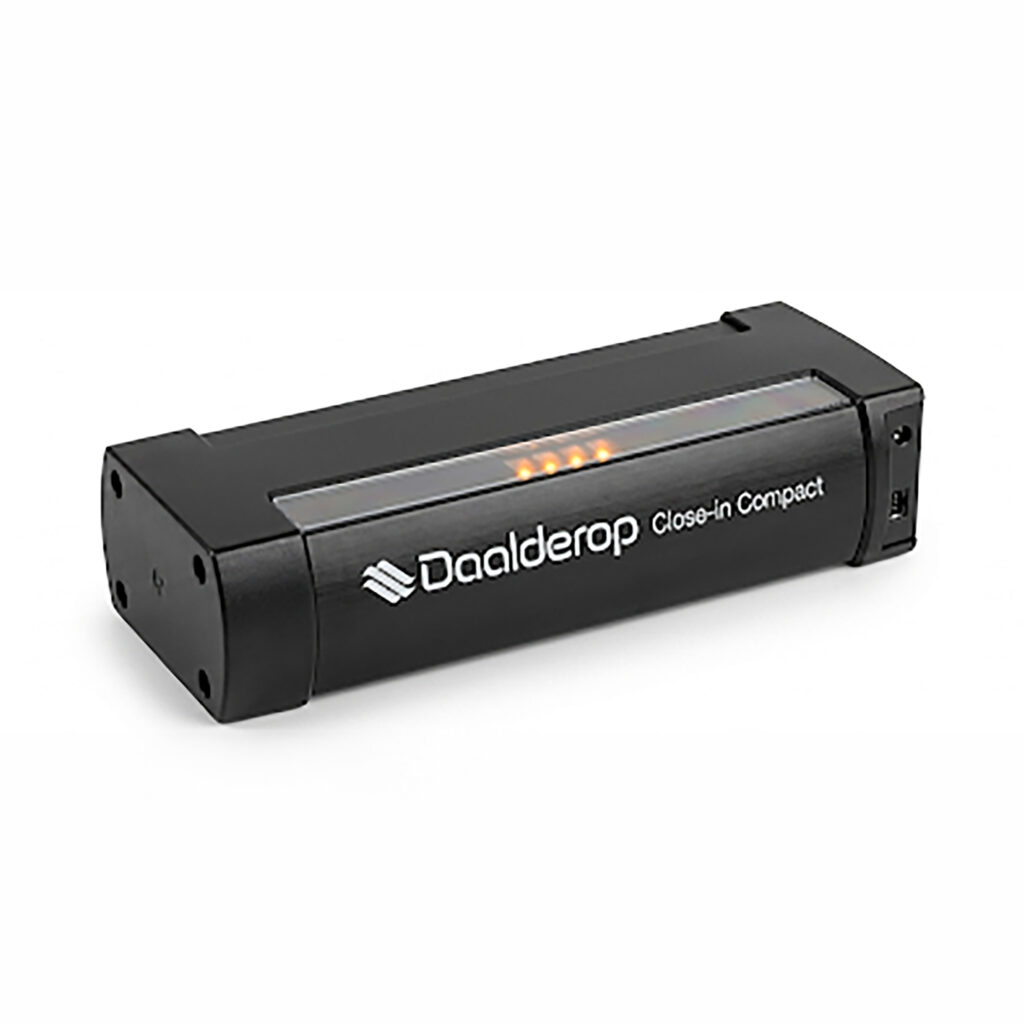
We would eventually go on to sell 3D printers ourselves — but more on that in the blog covering the years 2010–2015.
A Distinguished Visit to Design8 bv
Ben’s network included a tax adviser who could help facilitate the move to a private limited company. And so it was done. Design8 was born, and I relocated to Stephensonstraat in Tiel.
Two months later, in December 2005, we received a visit from two Channel Managers from @Last Software, the makers of SketchUp. A distinguished visit indeed. It was a nerve-wracking moment — Design8 was brand new: were we even allowed to remain a distributor? It was all or nothing, and I suspect I didn’t sleep for several nights.
An interesting footnote: one of the Channel Managers had come from the United States. She was enthusiastically photographing her way across Europe and was organising those photos using a new product being developed by the SketchUp team. Working title: Grizzly. You would later come to know it as LayOut, the 2D companion to SketchUp 3D. It was an Adobe-style application with considerable flexibility. If it succeeded, I was told, Adobe might find itself in trouble. Looking back from twenty years on, I know now that you don’t unseat the real giants quite so easily. Too big to fail, as they say. And LayOut — it’s been developing steadily, but it hasn’t quite become the killer app many hoped for.
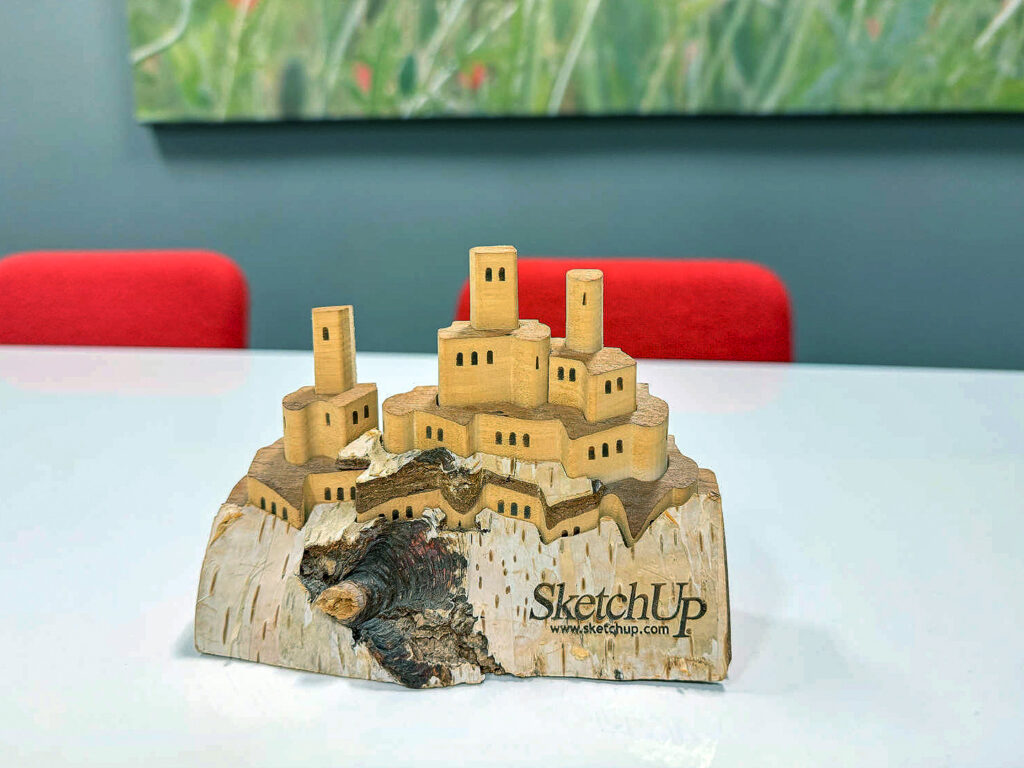
The other manager had come from Germany and arrived bearing a gift. At a local arts and crafts market, he had come across an artist who made sliding houses from blocks of wood. “Push-Pull Houses, I call them!” he declared, in an unmistakably German accent. It remains a wonderfully fond memento of a good, old, and nerve-wracking chapter — and it still sits on our meeting table to this day.
The visit went well, and our collaboration continued.
Google Acquires SketchUp
Three months later, in March 2006, the phone rang. Another of those moments I remember with perfect clarity. I was driving when the German Channel Manager came through on the car kit, in his unmistakable accent: “Orlando! SketchUp has been bought by Google!!!“
GOOGLE! I knew Google from their search engine and associated it with free software — they made their money through advertising, after all. I nearly swerved off the road, convinced the adventure was over.
But once again, we were allowed to stay. And indeed, a free version arrived. But the paid version lived on as SketchUp Pro — and if you’ve ever wondered where the Pro in the name comes from, that’s your answer. It did cause confusion in the market, and two commercial challenges came with it: first, the free version could be used commercially without restriction; and second, Google had decided that everyone would receive a free upgrade to SketchUp Pro 6. That stung.
Let me explain. These days, we sell predominantly annual subscriptions, which is convenient for customers — costs are spread out, and they always have support and the latest version — and convenient for us, as it makes revenue more predictable. But in 2006, you paid once for a perpetual licence. Under that model, being able to sell the occasional upgrade matters. Not in 2006. A frustrating blow.
In the long run, though, the Google acquisition brought a great deal of good with it. Everyone knows SketchUp now. In fact, we still get calls almost every week from people referring to it as “Google SketchUp.” And — rather embarrassingly — I’ve occasionally caught myself doing the same, saying Google instead of Trimble.
An Extensive Library of 3D Objects
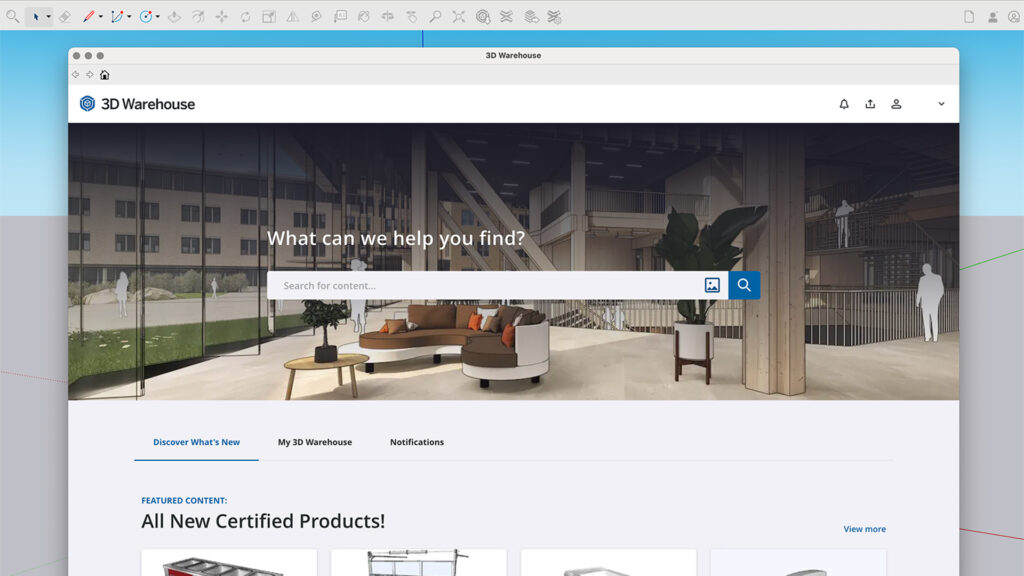
In 2008, Google introduced the 3D Warehouse. It was — and still is — an online space where any SketchUp user could download 3D models, and any SketchUp user could upload them.
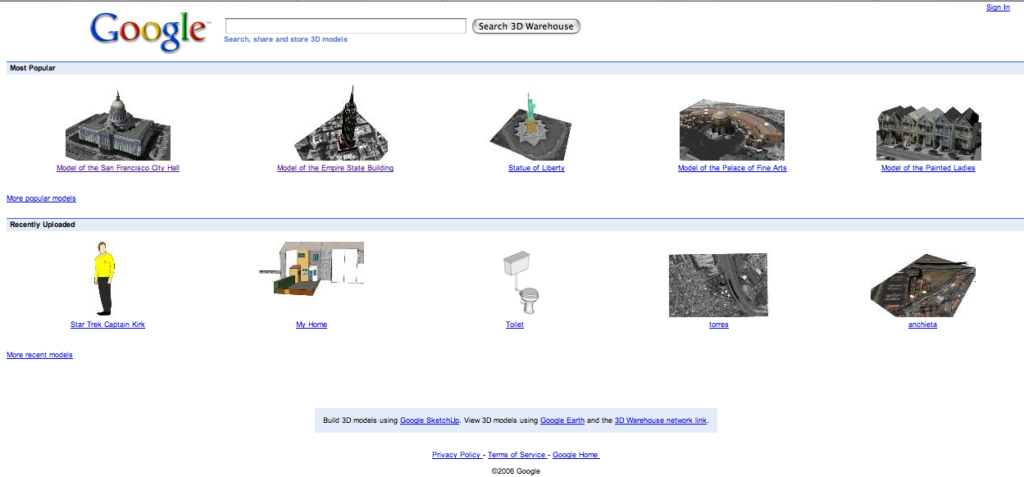
A great many objects no longer needed to be drawn from scratch; they were already available ready-made. That opened up some rather appealing possibilities.
The Perfect Match for Trade Fairs
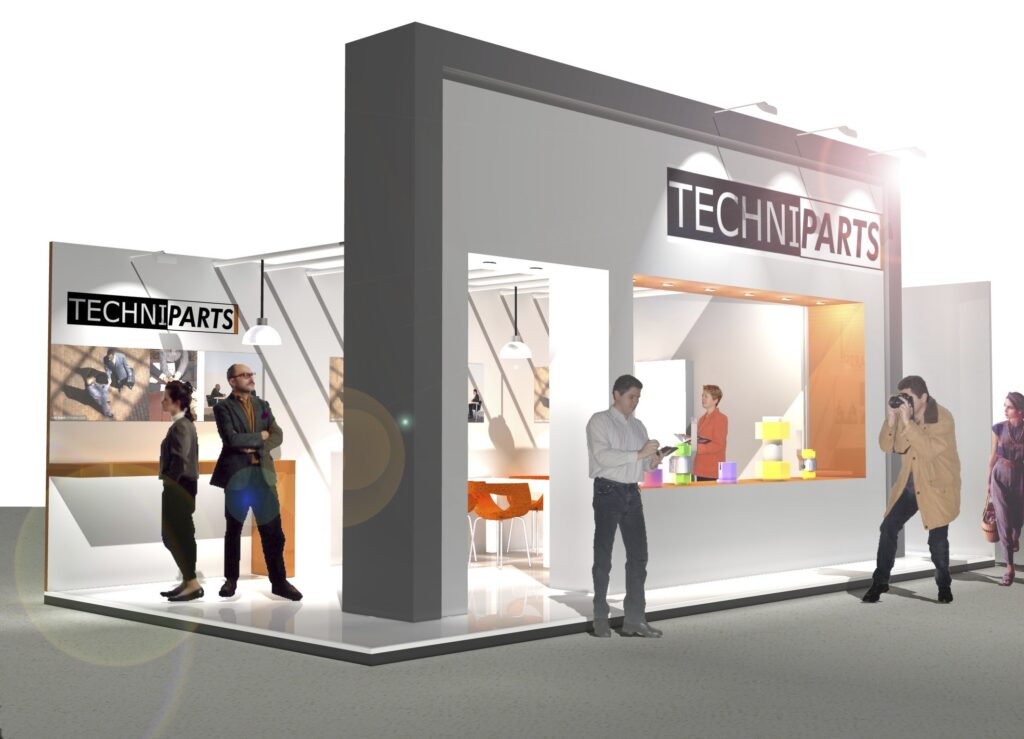
A client pointed out how well SketchUp suited the stand construction and trade fair market. The 3D Warehouse, in particular, was an exceptionally smart tool for that world. Stand construction relies heavily on standard objects and components, so if we made the most commonly used materials, furniture, and exhibition fittings available in the 3D Warehouse, SketchUp would become very attractive to that audience.
As mentioned earlier, we made good use of interns, to whom we gave well-defined briefs — drawing up plans to approach specific target markets, find resellers, build financial projections, and so on.
Two and two made four, so we brought in intern Robert van Dee to create a stand construction collection for SketchUp and bring it to market. We reached out to several suppliers to the exhibition industry and drew their objects in SketchUp. Robert did, rather. Once again, SketchUp’s ease of use proved itself: a commercial economics student churned out one 3D model after another with no prior 3D modelling experience whatsoever.
To promote SketchUp, we joined an initiative by ExpoGamma called the ExpoBorrel — a series of networking events held at various venues across Belgium and the Netherlands. The ExpoBorrel ran for more than twenty-five editions.

The 3D Warehouse still exists today and now boasts millions of models and users. Nowadays, those booth construction models are simply available there for free, and many manufacturers now have an official account featuring their 3D models. Ready for SketchUp!
Click here for an overview of stand construction 3D models on the 3D Warehouse.
Modelling for Google Earth
The 3D Warehouse had by now gained an additional feature: Geo Location.
Here’s how it worked. In SketchUp, you could import a location on Earth and draw a 3D model on top of it, making that model “geolocated” — placed exactly where it belonged in the real world. You could also texture the facades of your model with photographs of the actual building and achieve a surprisingly convincing result. And here’s the key part: once you uploaded such a model to the 3D Warehouse, you could tick a box confirming it was accurate, well drawn, properly textured, and correctly placed. At that point, someone at Google would personally review it — and if approved, your 3D model would go live on Google Earth!
We were convinced this was the very reason Google had bought SketchUp. And we threw ourselves into helping build the Earth in 3D. No small undertaking.
We helped launch a label into the world: EarthExposure. Complete with its own website. Getting your models in front of the world wasn’t entirely straightforward, however. First, someone had to download and launch Google Earth. Then they had to enable the 3D Models layer. And then navigate to the right location. But when they did — there was your 3D model, visible to anyone on Earth. What’s more, you could attach additional metadata and hyperlinks to your website directly to the model.
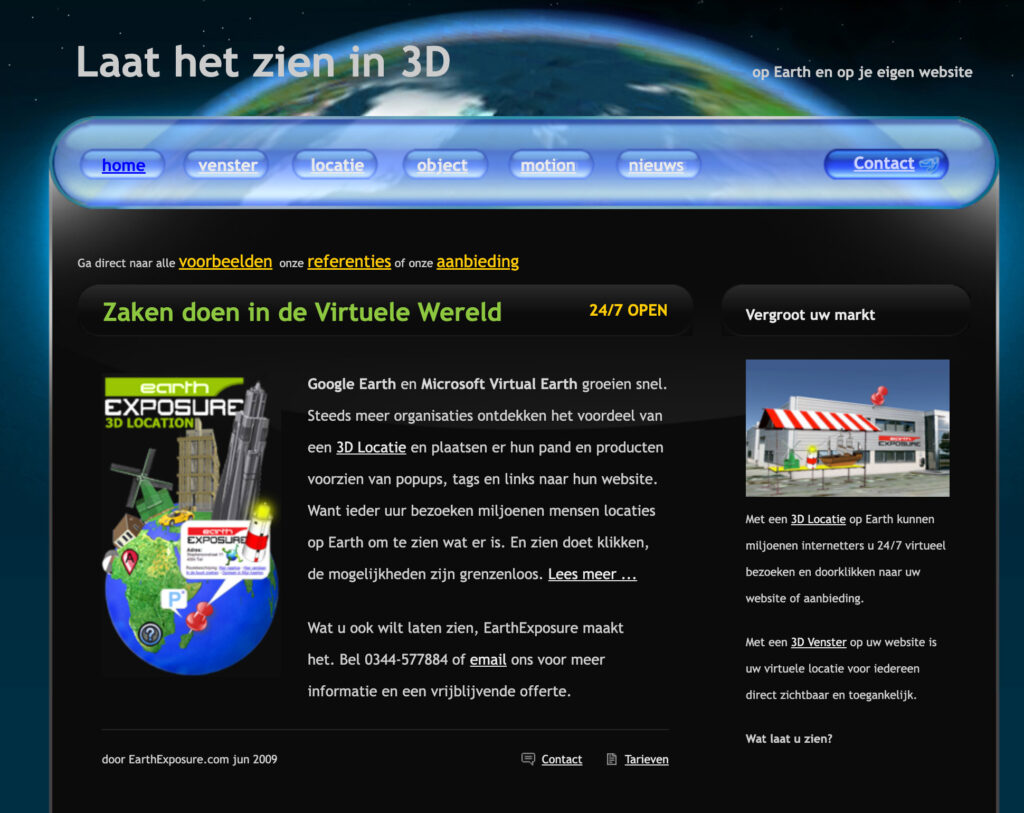
We managed to convince a fair number of companies and institutions that this was the new way to put themselves on the map. We modelled in 3D for Google itself, flew to Milan to model the Torre Branca in 3D, and placed the Noordbrabants Museum on Google Earth. That last one was a particularly enjoyable project.
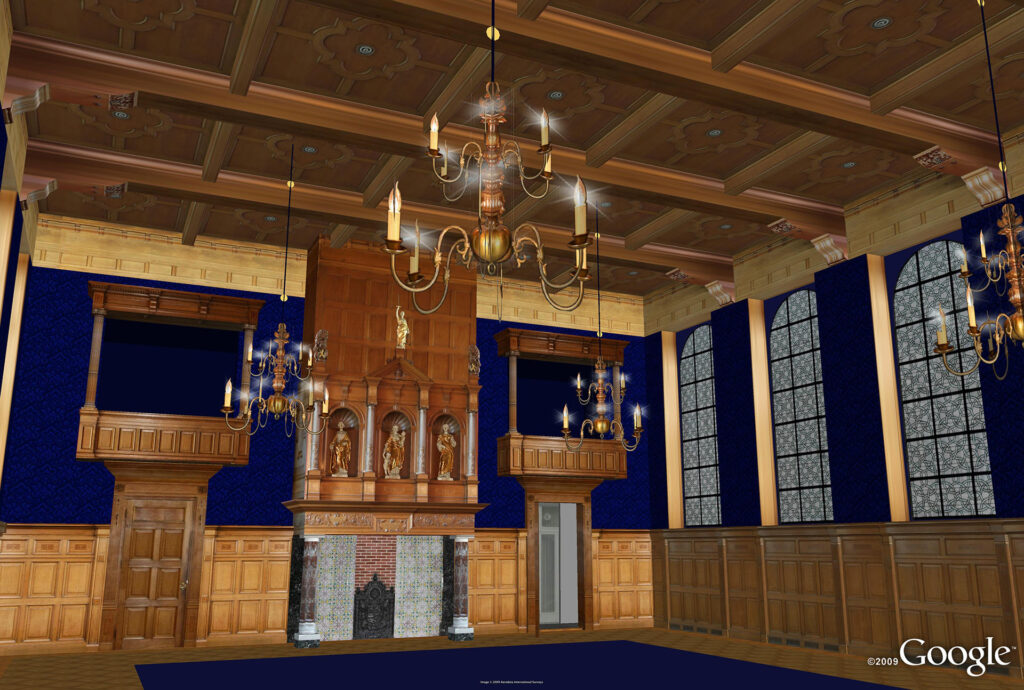
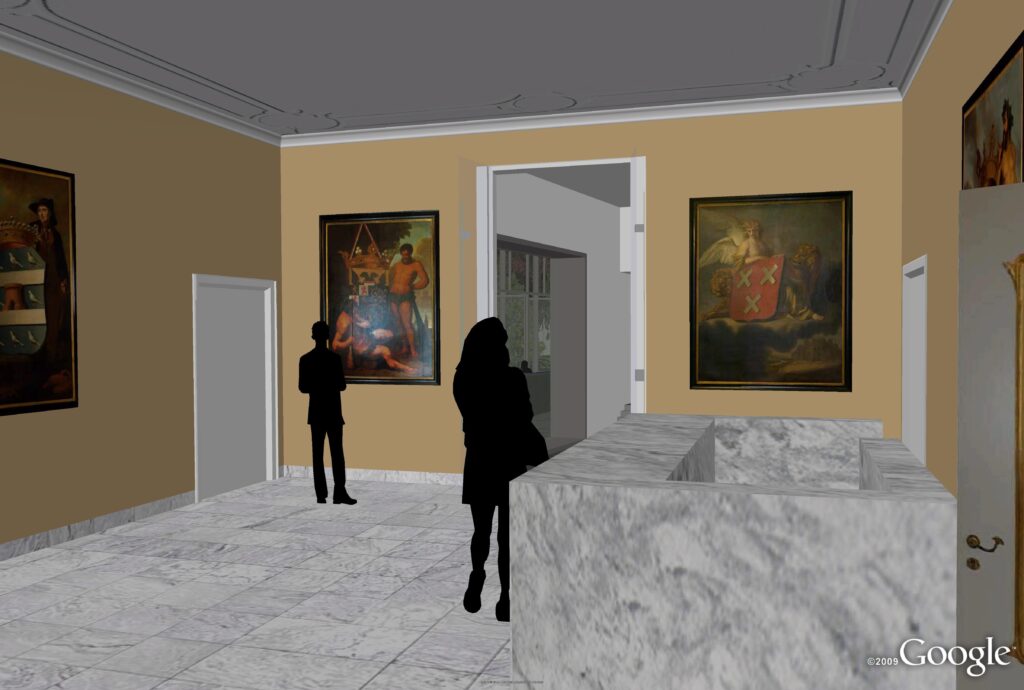
The Noordbrabants Museum was closing for renovation. But the director had come up with the idea of keeping it open on Google Earth. Now that’s vision. So we modelled the whole ensemble in 3D — the museum, the gardens, and the artworks — and published it on Google Earth. Our direct lines to Google proved invaluable here, as getting all the models approved required no small amount of effort.
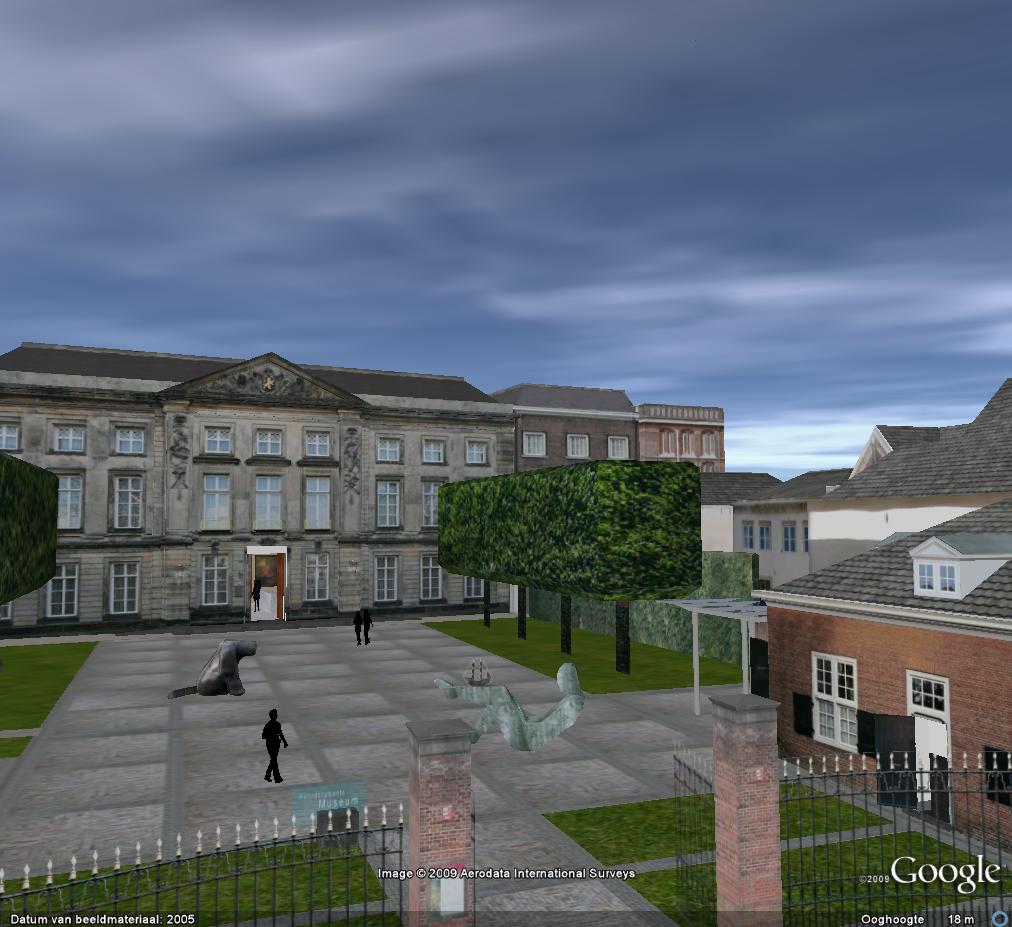
Google continued to push things further. It became possible to embed a block of code on your website that would display a Google Earth window showing a location of your choice, including 3D models. We embedded such a window on the museum’s website. The director invited the press for a presentation, which, unfortunately, didn’t go entirely to plan. The very night before the event, the Google Earth browser plugin had updated. It contained an unfortunate bug: all models larger than 1 MB failed to load. Our museum model happened to be 65 MB.
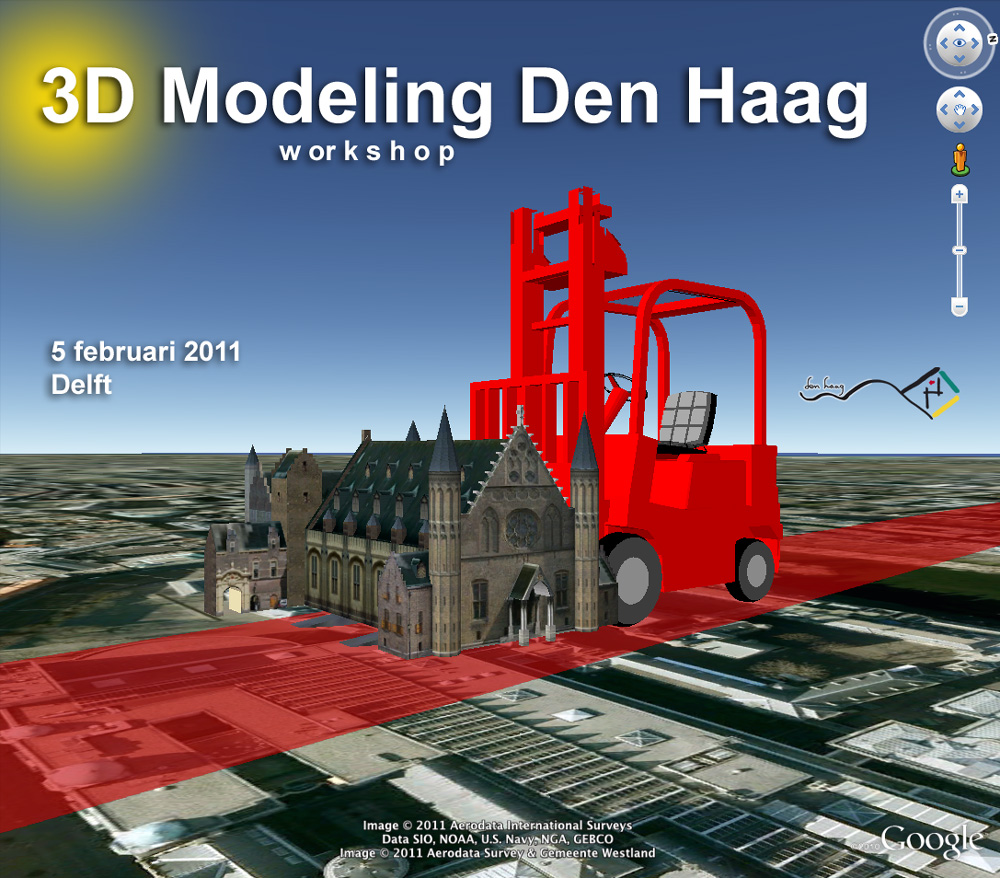
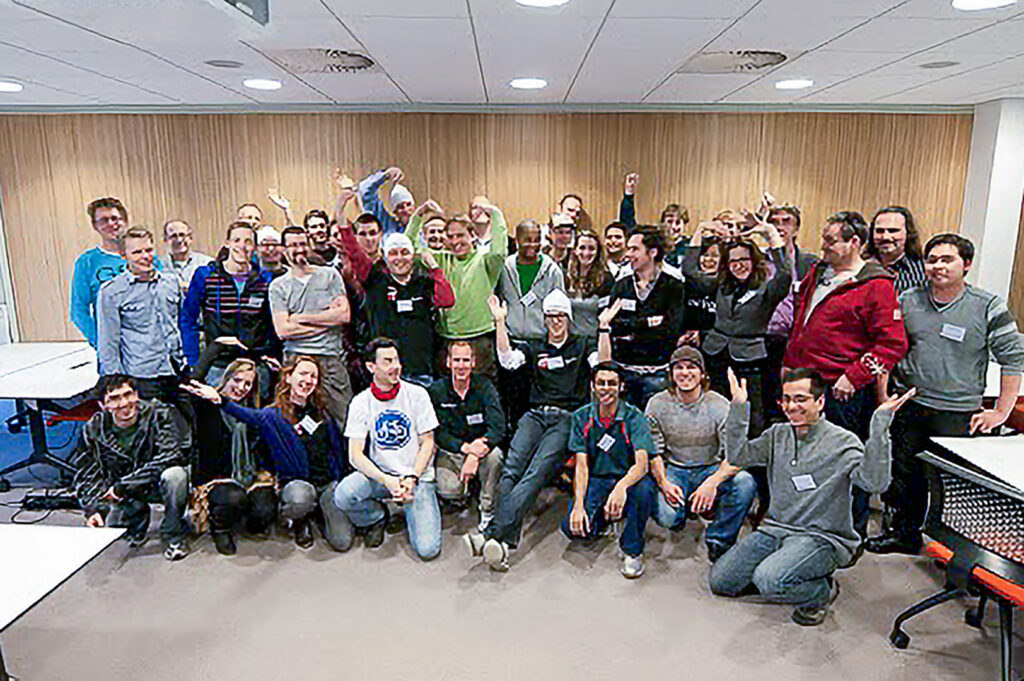
Google went a step further still and developed Building Maker — an online, though very limited, modelling tool that lets you quickly and easily create simple 3D buildings for Google Earth. Together with Google, we organised a “Build your City” workshop in Delft and modelled parts of The Hague.
I genuinely believe Google had a vision for a virtual world in 3D. But SketchUp wasn’t the way to get there. The models you find on Google Earth and Maps today are generated automatically using photogrammetry. And the importance of Street View should not be underestimated.
Google would eventually sell SketchUp to Trimble. You can read all about that in the next blog, covering the years 2010–2015.
We Suddenly Appear on the Artlantis Website
The phone rings one morning. “Hello, I’d like to buy Artlantis,” came the voice. Odd — we didn’t sell Artlantis. “Oh yes, you do, you’re on their website!” That is, it turns out, one way to acquire resellers — one we hadn’t thought of ourselves.
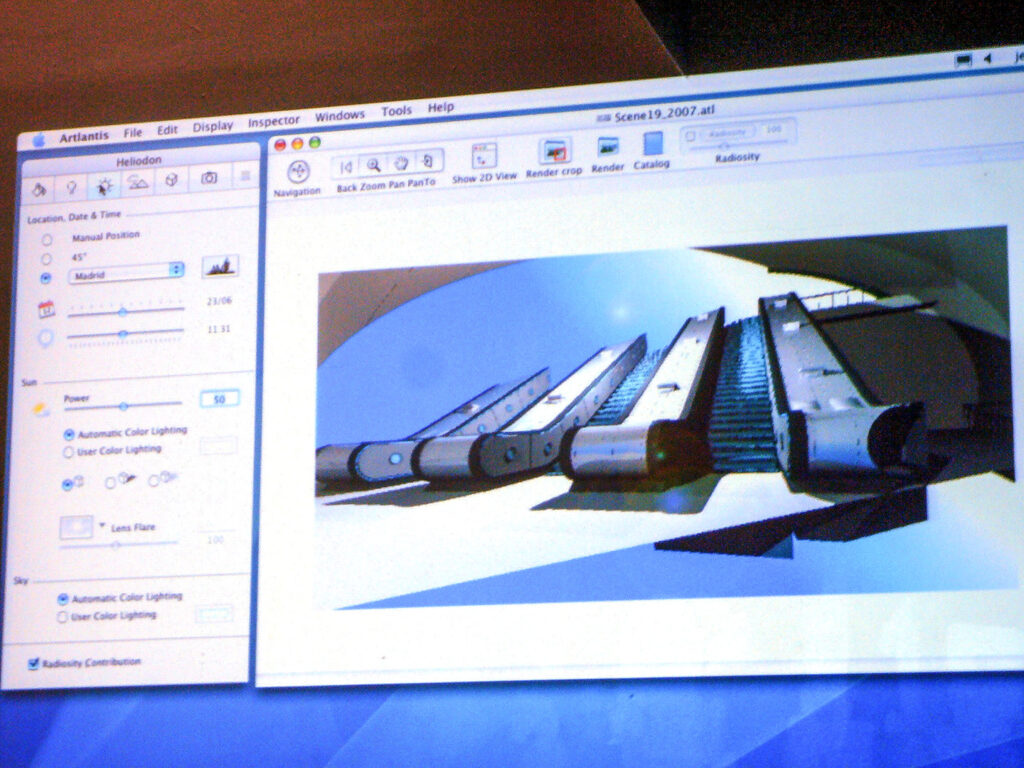
We were caught somewhat off guard. But from that moment on, we sold Artlantis: a rendering application from the French SketchUp distributor (Abvent, as they were then known) that didn’t produce the most beautiful renders, but was extraordinarily fast, with a real-time preview. That went down very well with our customers and resellers, and it quickly gained popularity. We weren’t yet selling a great many titles, so Artlantis was a very welcome addition.
For some customers, rendering was still a bridge too far. We helped those clients by producing images and animations ourselves. Rendering had become considerably faster than in 2000, but an animation could still take an entire night. Our Macs worked hard. The Windows machines, however, had ideas of their own: they had a habit of quietly installing operating system updates in the middle of the night, leaving us in the morning with a freshly updated machine and a crashed render.
First Aid for Design… or Disasters?
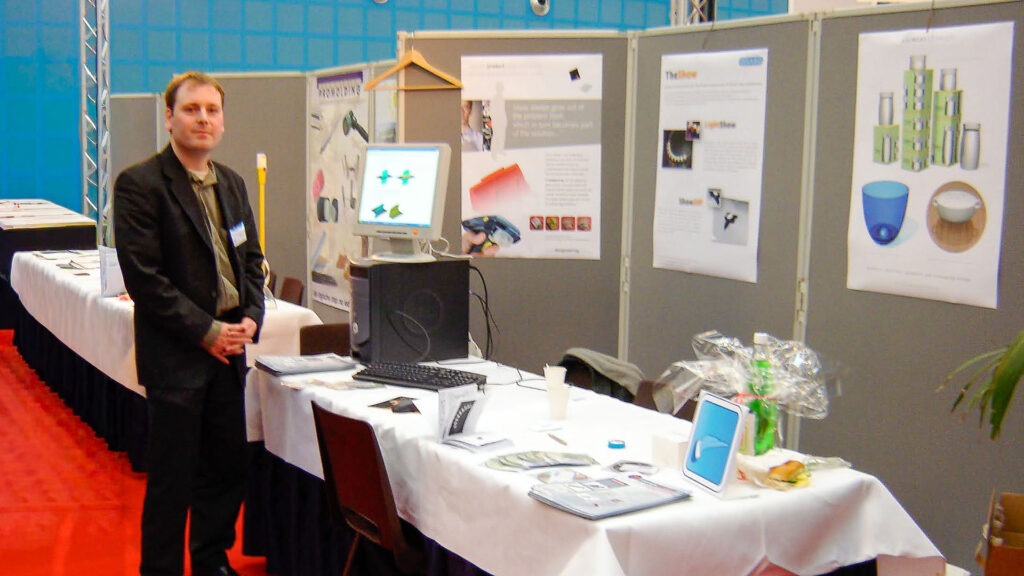
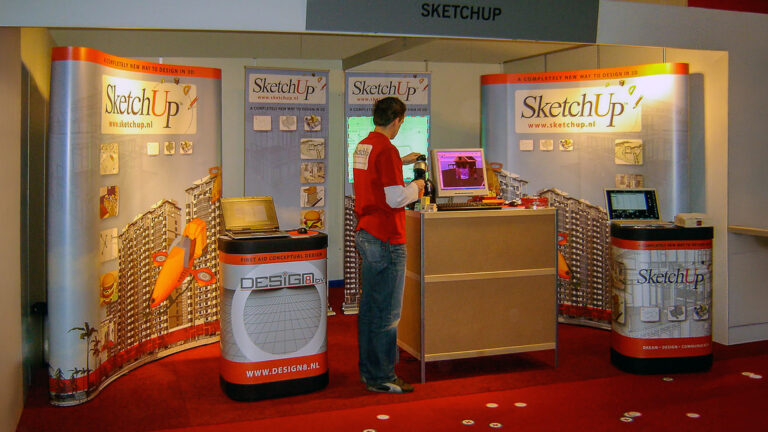
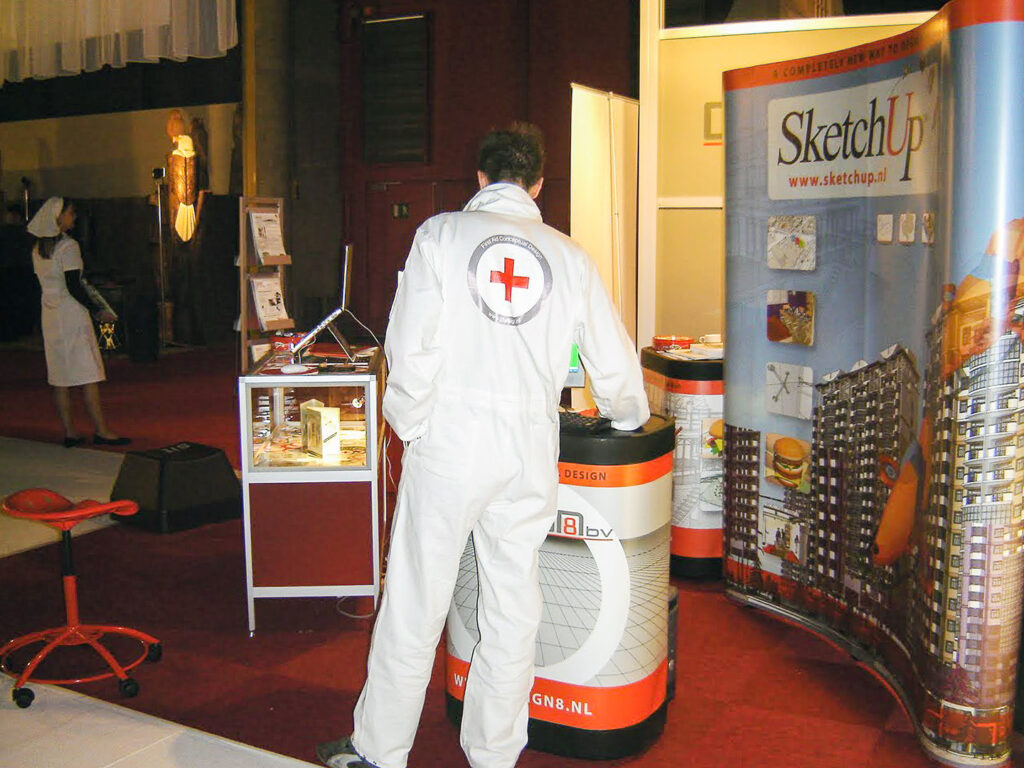
Our marketing budget was growing, and we began exhibiting at trade fairs — with the Bouw & ICT fair in Utrecht becoming a regular fixture. We also made appearances in the events industry. Alongside the ExpoBorrel partners, we exhibited at a fair called Eerste Hulp bij Beurzen (First Aid for Trade Fairs) — a theme that suited us rather well, given the cross in our (now retired) logo. We blended in so convincingly that someone actually approached our stand with a bleeding finger, asking if we happened to have a plaster.
Trade Fairs, Trade Fairs, and More Trade Fairs
Many more successful fairs would follow. We rarely stood alone — more often than not our resellers were with us, which was ideal: we could send interested visitors directly their way for a purchase.
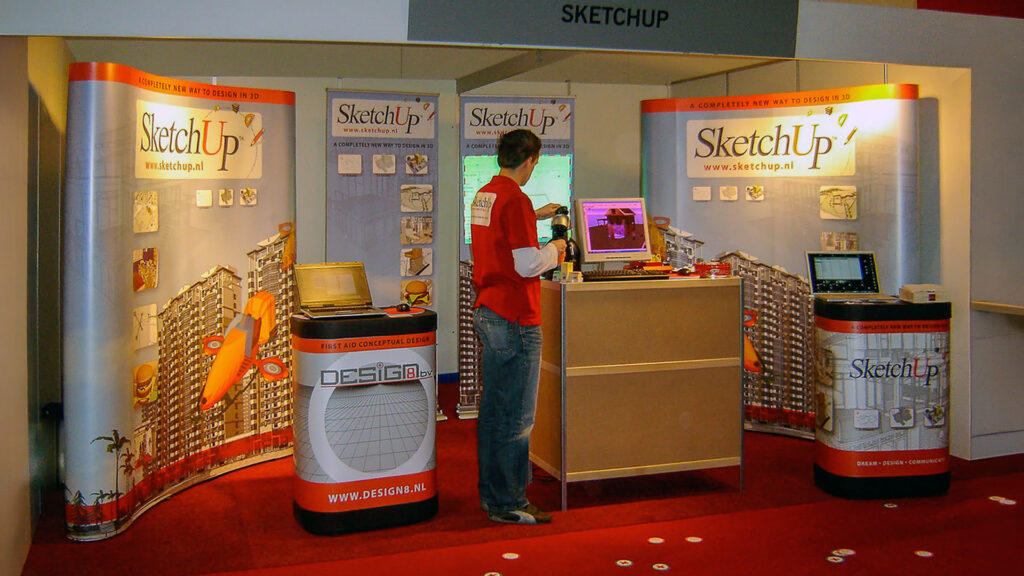
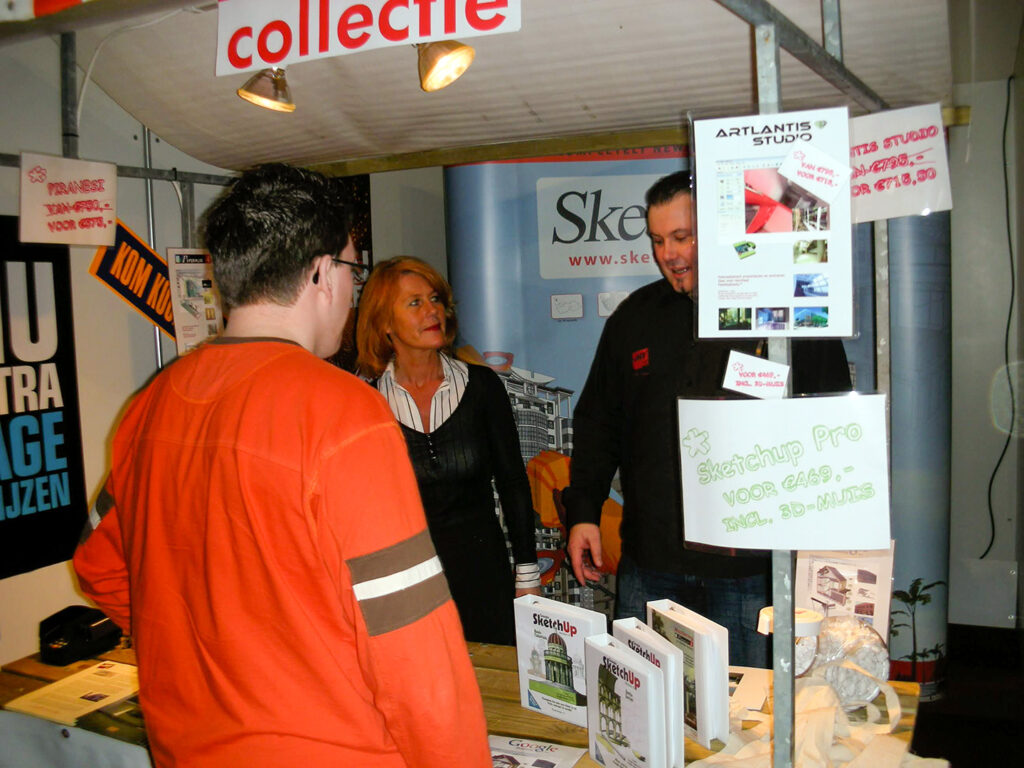
SketchUp was so accessible that reseller VMV had come up with the idea of selling licences directly at the fair. On the stand — a market stall, fittingly enough — visitors could pay for the show offer on the spot using a mobile card reader. It worked a treat.
The Bubble Bursts
By this point, some American banks were struggling with mortgage holders who could no longer meet their repayments. And so the property market collapsed. The bubble burst. It took a while to reach us, but when it did, we felt it too. How badly, and how did we deal with it? That’s for the next blog, covering the years 2010–2015.

About the Author
Orlando Sardaro (1972) studied Industrial Design at TU Delft and founded Design8 in 2005. From Design8, he sells and supports design software, primarily through resellers. Orlando never loses sight of the end user and keeps a close eye on developments in the 3D market. In his spare time, he enjoys 3D modelling, Nutella, pizza, coffee, red wine, bread, chocolate, Italy, golf, Porsche, Apple, and sunshine.